IDEAL Melons Take Guesswork Out of Determining Cantaloupe Ripeness
Most consumers know a few tricks to picking out the best watermelon at the supermarket. But, what they don’t often know is how to pick a good cantaloupe. Thanks to the recently patented Harvest Indicator Trait, Syngenta Vegetable Seeds is making it easy to choose a sweet, juicy cantaloupe — every time.
So, what’s the hardest part about choosing a cantaloupe? The exterior is always the same color, but the actual ripeness varies widely. Enter long-shelf-life (LSL) IDEAL Melons with the Harvest Indicator Trait, which change color externally to signal ripeness.
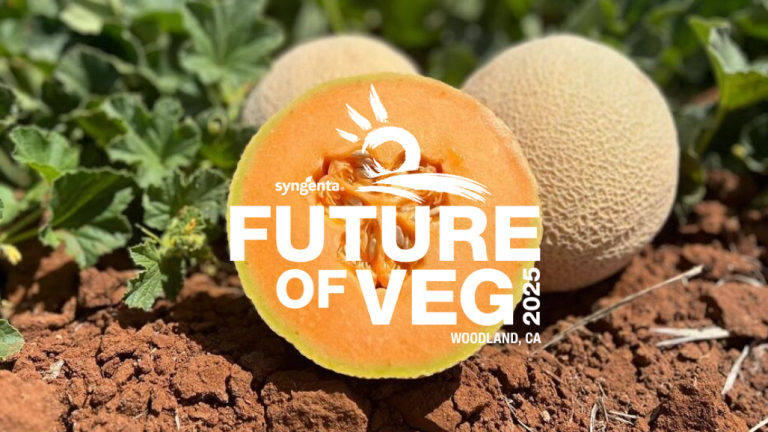
Taste and see IDEAL Melons at Future of Veg in Woodland, Calif. Aug. 13-15, 2025.
IDEAL Melons Rinds Continue Changing After Harvest
A 2024 study by UC Davis found that IDEAL Melons continue to change color externally after harvest, reaching a color-change stage of between four and six. In comparison, standard LSL melons reached a three.
With this external indicator of ripeness, growers can be sure when to harvest and find the perfect timeline for transit. And, all of this comes without sacrificing taste — the continued ripening after harvest also results in higher sweetness and a stronger aroma.
“We know that with previous long-shelf-life melons, there were challenges that impacted not only growers, but consumer’s perceptions of the fruit,” said Bernie Hamel, Value Added Chain Lead. “With Syngenta Vegetable Seeds IDEAL Melon varieties that feature the Harvest Indicator trait, we’re addressing those challenges to create a melon that growers and consumers will love.”
Helping Consumers Pick a Better Cantaloupe, Every Time.
IDEAL Melons’ exteriors color – even in cold storage. This means when the melon hits grocery store shelves, it’s at peak ripeness, while growers can still maximize harvest efficiency.
“What growers and farmers have been most surprised about with the IDEAL Melons is that you can harvest at 60% color change and it will continue to change color and ripen as it goes through distribution and hits shelves,” Skyler Zapata, Syngenta Vegetable Seeds Product Specialist – Cucurbits, U.S. West, said. “In addition, (the color change means) it is easy for harvest crews to identify which melons are ready, thus improving the quality of the overall bin in the grocery store. Not only does it help the consumer visually, but there are less unripe melons in the bin this way.”
Most LSL melons have a reduced amount of ethylene production, keeping the fruit at a similar ripeness from field to store shelves. This is beneficial for a longer shelf life and more durable fruit but lacks traditional visual cues regarding ripeness. Unlike traditional LSL melons, IDEAL Melons continue to change color and ripen after being picked and have about a two-week window from harvest to peak ripeness.
While other melons that change color after harvest exist, they typically change to a yellow hue while IDEAL Melons are a golden straw color.
Playing this video requires a marketing consent.
Click anywhere on the video to renew your consents.
Easier, More Accurate Cantaloupe Harvests
IDEAL Melons have the potential to help growers reduce labor inputs with better harvestability and less room for error.
“Instead of waiting for peak ripeness, a grower can harvest the field earlier, which saves on freight costs,” Zapata said. “They can also harvest two or three times compared to four or five times with a more traditional extended shelf life.”
During shipping and storage, IDEAL Melons performed similarly or better than other LSLs. Rakesh Kumar, Breeding Team Lead for Melon Breeding said, “In shipping and in storage, the melons maintained flesh firmness, sugar level, and overall performed well.”
IDEAL melons also include Syngenta Vegetable Seeds’ standard disease packaging, helps protect against powdery mildew 1 and 2 and fusarium 0, 1, and 2.
LSL Melons with Improved Aroma and Brix
IDEAL Melons have significantly more volatile organic compounds than other LSLs, leading to a stronger aroma, according to another study by UC Davis.
They also contain a significantly higher and more consistent sugar content (Brix) and higher amounts of dark orange flesh color (from carotenoids).
The unique combination of benefits that IDEAL Melons boast — a visual cue of ripeness, continued ripening after harvest, increased aroma and Brix — combined with disease packaging may have consumers switching up their favorite melon.
See IDEAL Melons for yourself!
2022 Research conducted by UC Davis. Associate Professor Barbara Blanco-Ulate. Department of Plant Sciences, Professor Cristina Davis. Mechanical and Aerospace Engineering, Distinguished Professor Hildegarde Heymann. Viticulture and Enology, UC Davis.
2024 Research conducted by UC Davis. Associate Professor Barbara Blanco-Ulate. Department of Plant Sciences, Professor Cristina Davis. Elia I. Gutierrez-Baeza, Horticulture and Agronomy Graduate Group.
These dates are a general guideline and variety performance will vary depending on geographical location, cultural practices and environmental factors.
All photos are either the property of Syngenta or are used with permission. The Ideal Melons logo and the Syngenta logo are trademarks of a Syngenta Group Company.
© 2025 Syngenta. Some or all of the varieties may be protected under one or more of the following: Plant Variety Protection, United States Plant Patents and/or Utility Patents and may not be propagated or reproduced without authorization. The Syngenta logo is a trademark of a Syngenta Group Company.