

Syngenta's ToBRFV Information Center
Syngenta was the first to announce ToBRFV resistance in late 2020, and the first commercial varieties were planted in early 2021. Since then, we’ve continued to work tirelessly to provide solutions for tomato growers.
Tomato Brown Rugose Fruit Virus has a significant impact on growers. In fact, growers can lose up to 70% of their produce due to the virus, and it's spreading rapidly. -Marcel Prins, Syngenta Vegetable Seeds Head of Germplasm Development, Solanaceae
Today we have varieties available with ToBRFV resistance, with many more in development. “Broad resistance will be built in the portfolio during the next several years,” said Marcel Prins, Syngenta Vegetable Seeds Head of Germplasm Development, Solanaceae.
We will continue studying and discovering new modes of action for resistance against ToBRFV with the big picture in mind. Whether its leaf curl, or ToBRFV, you need a disease package that gives you resistance to all key disease threats – not just the newest one.
“At the end of the day, we need to offer growers good commercial yield with good food quality,” says Stéphane Le Caro, Syngenta Portfolio Lead for Indeterminate Tomato, Passive Greenhouse. “For this reason, we are testing a lot of varieties to find the right fit.”
The ongoing research aims to expand resistance options and provide some that use different resistance mechanisms. Our researchers are diligent in developing the right ToBRFV resistance that also contains a complete package of resistances and adaptability to suit grower needs – without sacrificing the flavor consumers expect.
“We know our customers need resistance to ToBRFV virus, but also others that can be alone or mixed altogether,” Le Caro explained. “I’m considering especially tomato spot virus, which give symptoms very close to the tobamovirus, so we need to combine all of these in any new variety we deliver.”
More Resistance Varieties Are In Development
Syngenta currently has more than a dozen varieties with ToBRFV resistance available for commercial use in cluster, saladette, and oval mini for active and passive greenhouse.
“We won’t launch an incomplete product that simply has ToBRFV resistance and lacking everything else,” said Ernesto Hagelsieb, Americas’ Portfolio Manager, Tomato. “Our products bring the high qualities we’d expect, with ToBRFV resistance on top of it all.”
Our researchers are taking the resistance we currently have on the market and introgressing it into new varieties and new kinds of tomatoes. Research is ongoing to discover new resistance mechanisms to continue to provide growers with options.
“We know the virus is changing and it can cause a lot of damage, especially in yield, impacting the plant and changing its behavior,” said Arthur van Marrewijk, Syngenta Vegetable Seeds Product Specialist. “Viruses are unpredictable and hard to control. It’s our goal to go as fast as possible to bring new resistances to the market.

Playing this video requires a marketing consent.
Click anywhere on the video to renew your consents.
What is ToBRFV?




Resources From Syngenta To Help With ToBRFV
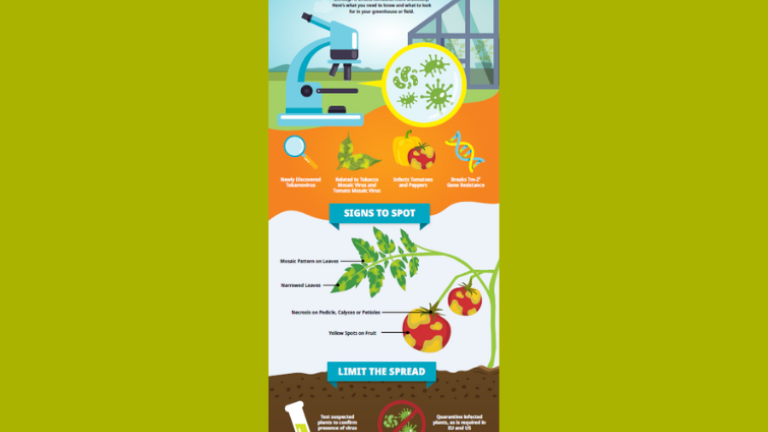

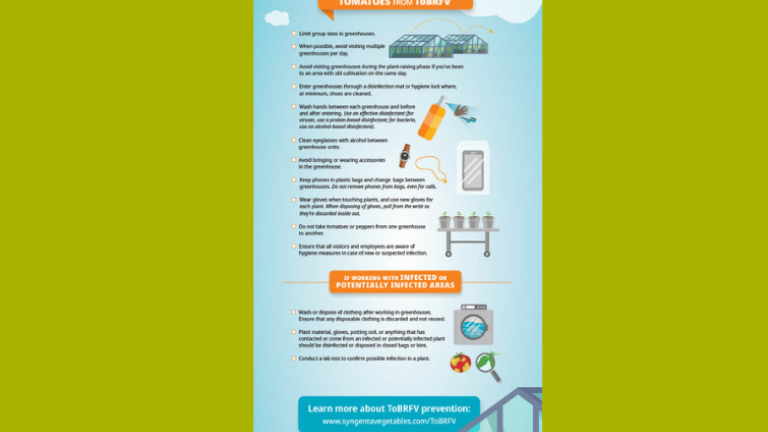
Keep Your Greenhouse Safe with These Hygiene Standards
It’s incredibly easy to be a transmitter of ToBRFV. It spreads on clothing, footwear, jewelry, and any tool used in infected tomato plants.
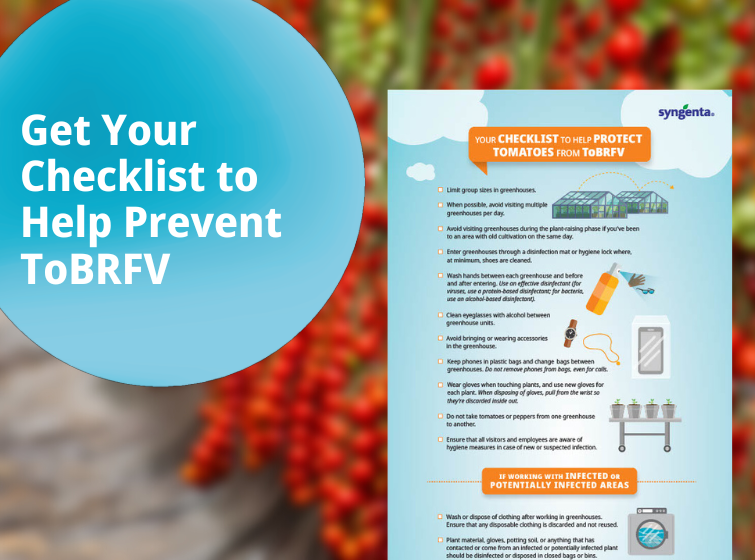
By adhering to extreme hygiene rules when visiting any greenhouse or field, growers and visitors can limit the translocation of ToBRFV. Follow these rules to reduce the spread of ToBRFV:
- If you’re in an infected area DO NOT go to other greenhouses or fields in the same clothing, shoes, etc.
- Upon arrival to greenhouses, use an effective disinfectant on hands, eyeglasses, and shoes and ensure clothing is clean of plant residues.
- Avoid visiting multiple greenhouses in one day.
- Do not take tomatoes, peppers, or any plant materials from one greenhouse to another.
- Avoid bringing jewelry, watches, accessories or phones into greenhouses.

Playing this video requires a marketing consent.
Click anywhere on the video to renew your consents.



Syngenta currently has the following five varieties with ToBRFV resistance available for commercial use:
To receive updates when new resistance varieties become available, subscribe to ToBRFV Information Center Updates.