Pepper Crop Info #3
Crop Info #3 2024 | Syngenta Pepper
Light Figures
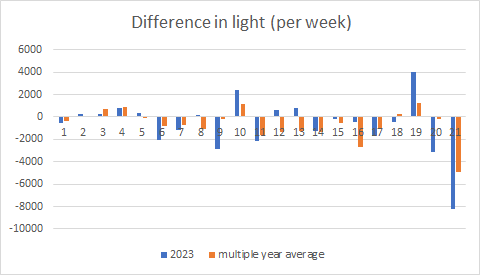
The graph below shows the difference in amount of light per week, where 2024 is compared with last season and the multi-year average. This clearly shows that we have been below the multi-year average and below the level of last year for a long time (with the exception of week 19).
Source: De Lier, Westland
Source: De Lier, Westland
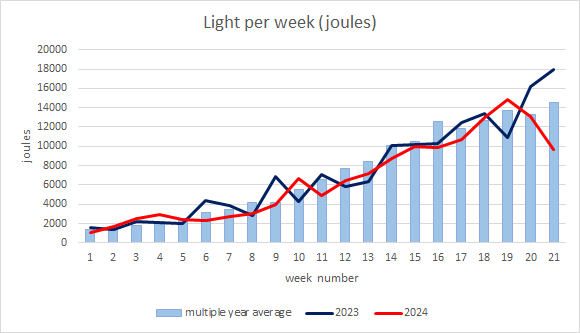
Looking back at the graph above, we see a constant line in the figures for 2024. Week 10 was a good week in comparison, and the following weeks were consistently below the multi-year average and below last year's figures. Cumulatively (as of January 1, 2024), we are 3% behind last year and 7% behind the multi-year average.
This year we see that the differences in irradiation between the days are greater than in other years, while the differences between the weekly figures are less significant. This makes for challenging climate management this year.
Temperature
The outside temperature has been higher than we are used to for a long time. Temperatures have been above average from week 10, except for weeks 16 and 17.
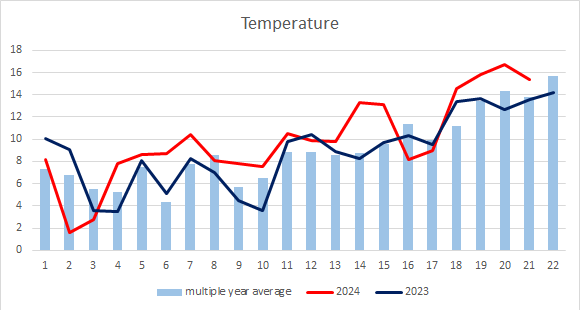
Source: De Lier, Westland
While in previous years the climate was normally very poor, this year we see that April and May are very humid with a lot of precipitation.
Bedena:
General
Bedena is our new red pepper variety with the total resistance package (Tm:1-3, Lt and TSVW:0) that is being grown commercially on a larger scale in Europe this year. Bedena is a generatively powerful variety that is easy to grow, with a fast colouring.
Review
Over the past period we can conclude that Bedena has performed very well. Due to the rapid fruit development and generative impact, we saw early, high production at the end of April. At that time the plant load was very high everywhere (around 40 st/m2) but we saw that Bedena retained sufficient growth vigor. Despite the high plant load, the fruit weight remained between 190 and 220 grams. From the beginning of May we saw the growing vigor increase and the plant continued to grow continuously with 5-7 pieces / m2 / week, which now results in a very nicely balanced crop.
The growers who increased temperatures with Bedena when the plant load increased now have the crop in the best balance.
Current situation
We now see that growth vigour (thicker stems/heads and more leaf mass) is starting to increase, which means that Bedena will have sufficient cooling capacity for the summer period.
The variety continues to produce highly generative flowers that set easily. Normally this period is characterized by a leaner climate and irradiation can rise early in the day while the outside temperature is still low and the moisture is dropping.
Outlook
General
To keep the fruit weight at the desired level, it is important to set a pre-night starting from the longest day.
The maximum plant load is 40 plants/m². If the plant load does become higher, we advise to reduce this by means of to bring back fruit thinning. We prefer to top on the 2nd leaf, so that you maintain sufficient plant mass. You must then remove the flower/fruit on the 2nd leaf.
For crops that are a bit fuller, you can also continue topping on the 1st leaf throughout the season.
We advise to start topping on 1 leaf again from August.
Climate
Make sure that an active climate is maintained.
The steering options will be limited in the coming period due to the summer climate. It remains important to activate the crop in the morning and to be at daytime temperature before sunrise. This also allows the plant to cope better with weather transitions. As mentioned earlier, we know from experience that the growth vigor of Bedena increases as the amount of light increases. At the same time, Bedena retains its generative nature, which means that the plant load remains sufficiently high. This combination of vigour and generativity often delivers the best performance in quality and production.
Water
Aim to have the first drain around 11am. Maintain a dose of 2.2 – 2.5 times the irradiation.
Avoid large fluctuations in EC.
Root problems in peppers
This season we started a project focused on the root problems we have seen in recent years.
We take monthly measurements of outlet and drain water to monitor what is in the water. We do this at several companies, so we want to get a good picture of the changes in the values we measure in the water.
You can read more information about our research here.
You can expect the following cultivation information in week 27.