“With ToBRFV, don't focus blindly on IR or HR.”
“With ToBRFV, don't focus blindly on IR or HR.”
Resistance to the ToBRFV virus is a common topic in discussions between tomato growers and their advisors. Breeder and plant virus expert, Marcel Prins, sees that misunderstandings can easily arise and is happy to contribute to the discussion based on his professional knowledge. “Hygiene measures are and remain important.”
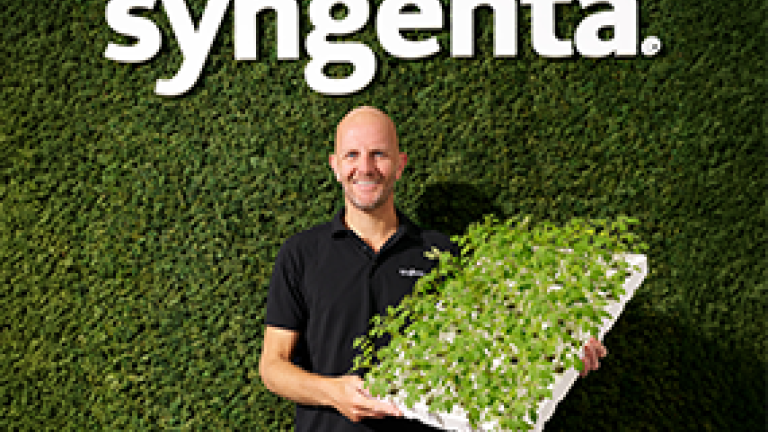
“Don't get me wrong,” Marcel Prins opens the conversation. “Of course resistance is important in the fight against the ToBRFV virus. It is not without reason that we, at Syngenta, are working daily to expand our portfolio of resistant varieties. And I will always advise a grower to grow a resistant variety. But in conversations with growers we notice that misunderstandings easily arise on this subject.” Prins has been head of pepper and tomato breeding at Syngenta Seeds since 2021. Before that, he was involved in the development and application of new breeding techniques at Keygene for 15 years and a professorship in applied plant virology also appears on his CV.
Resistant rootstock
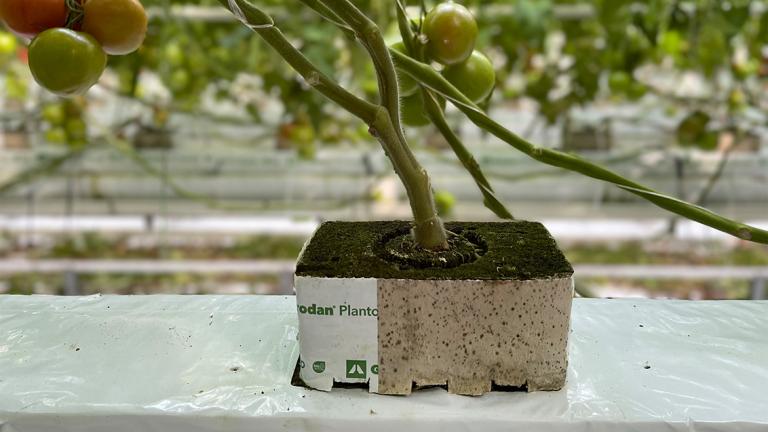
You can discuss many things with Prins, but he has a strong opinion about the importance of a ToBRFV resistant rootstock. “I would always choose that. If a plant becomes infected, the virus will always first move downward to the rhizome and then move upward through the plant. If the root system is not resistant, you will get the virus multiplication there and that is the last thing you want. You don't have to give up on the yield. At Syngenta we have 4 resistant rootstocks that perform as well or better than non-resistant rootstocks. So you don't have to choose a compromise; you simply get a strong rootstock that also contributes to limiting the virus.”
Complex matter
There are several reasons for possible misunderstandings about resistance, says Prins: “The most important reason is that there is no official standard protocol to measure the effectiveness of resistance. The boundaries between sensitive, intermediate and highly resistant are also not clearly defined. If a breeding company wants to determine the degree of resistance of a new variety, it will do so under the conditions for which the variety was bred. But if that variety is grown under different conditions in practice, consciously or unconsciously, the effectiveness of the resistance may be different.” The genetic source or sources of the resistance also have an influence. “I can talk about that for a day,” Prins laughs, “But it quickly becomes too complicated. I sometimes hear it said that you need multiple genes for high resistance. From a purely breeding technical point of view, that statement is incorrect. But when two or more resistances from different sources have been crossed into a variety, the resistance will probably be stronger and less likely to be broken than with a single resistance. But even that is not a law of the Medes and Persians because there are known examples in which an IR breed performs better than an HR breed. And an HR variety can also contain viruses after an infection, especially with the sensitive Q PCR detection. All these things make it difficult to make a good comparison.”
Plant performance
Syngenta is always on the cautious side with its resistance typing for ToBRFV, says Prins. “We currently have 15 commercially available varieties with ToBRFV resistance and dozens of varieties with that resistance in trials. These are single resistances and we characterize them as IR. Our first variety will be launched on the market at the end of 2024 with two resistances, which will then be HR. Because we have breeding stations all over the world, we can test our varieties in many climates and under different conditions and thus avoid surprises. ”
According to Prins, it is especially important for growers to focus on maintaining the effectiveness of a resistance and to assess a variety on how it performs in the greenhouse. “In the end it's all about the result for the grower. Resistance is nice, but it is especially important to test that resistance as little as possible because then you will benefit from it for the longest time.” And with this, Prins brings up the importance of company hygiene. “It won't be news, but hygiene is crucial to keep infections at bay. We have an advantage in that area in the Netherlands because we grow here in closed systems and on substrate. It is then up to the grower to regularly disinfect machines, materials and clothing and to minimise the number of human-plant contacts. So not too many different people in the greenhouse, good personal hygiene and trying to limit the number of crop operations. Good zoning in the greenhouse can also contribute. And keep your irrigation water clean.”
The second aspect, ensuring an optimally performing crop, is mainly a matter of the grower's green fingers, says Prins. “A plant that is in its element will always be less bothered by attackers than a plant that is stressed. And if you do get an infection, the resistance ensures that you retain a marketable yield. But resistance is no guarantee that you will not get an infection.”