
What has the climate been like so far, and how have the plants responded?
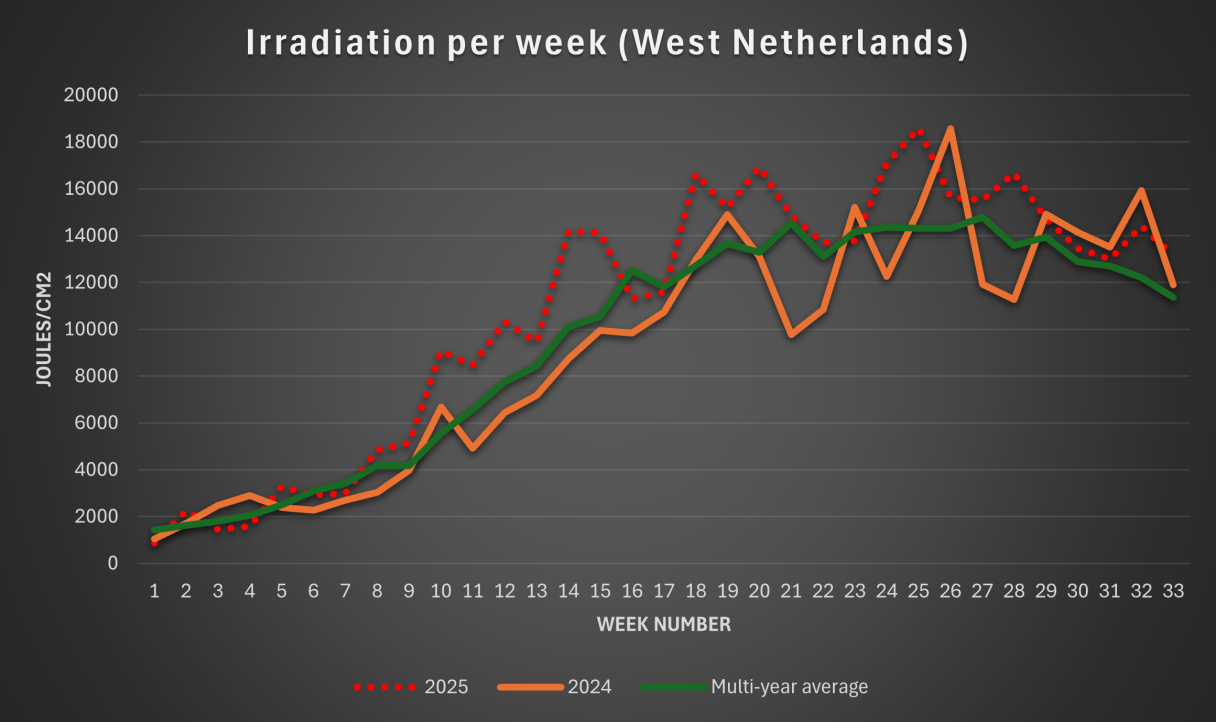
From early July, the weather conditions and irradiance have been somewhat variable. The absolute light sum from early July to mid-August is slightly lower than the multi-year average.
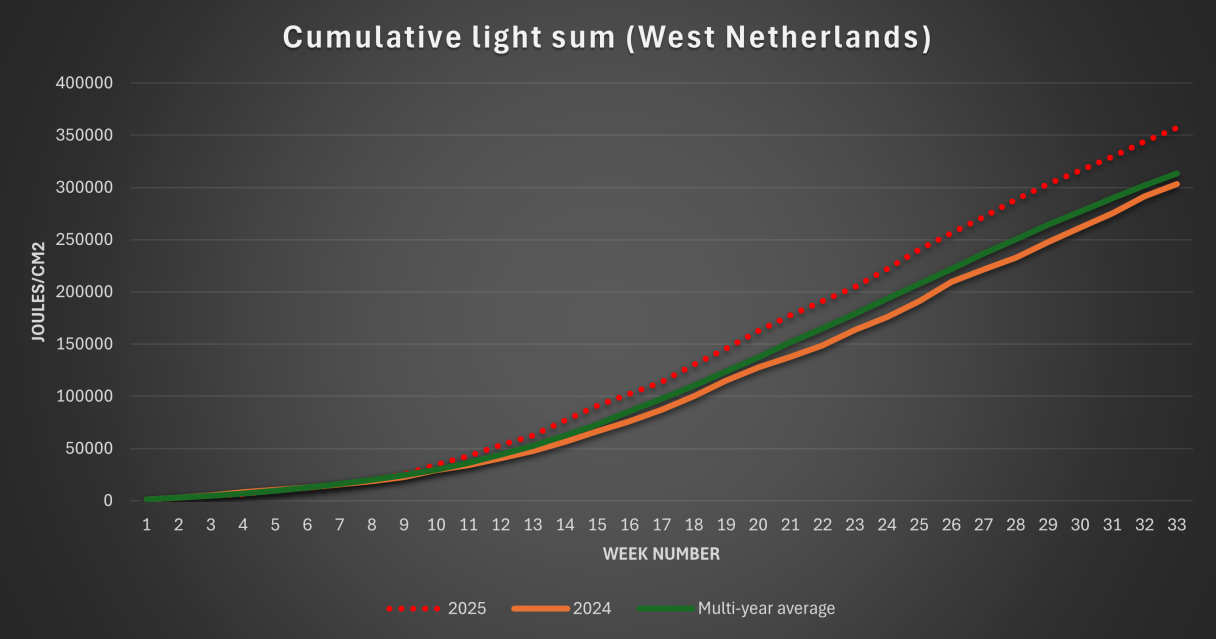
Due to the very bright spring and early summer, the cumulative light sum is still considerably higher. The graphs show that the cumulative light sum from week 1 through week 33 is a whopping 53,000 J/cm² (18%) higher than last year and 14% higher than the multi-year average!
Light sums in the West of the Netherlands, up to and including week 33
Impact on crop status / plant load
Due to the abundant light, production in all segments is generally higher than last year.
In recent weeks, the development time for snack tomatoes was at a minimum of around 35-37 days. This will increase again from now on due to the decreasing radiation. The plant loads we are seeing along the way vary enormously, from around 500 to over 650 plants per m².
As in previous years, we are seeing rising humidity levels both outdoors and in the greenhouse, resulting in increased leaf length.
Current situation of our varieties
Prodelle and Duelle
Plant vigour and fruit weight:
Prodelle and Duelle easily maintain sufficiently strong trusses, even in the current warm weather. The percentage of split trusses is approximately 50-70%, sometimes even higher. The crops are well-balanced everywhere, with good flower production and a nice, rapid set. As a result, the plant load is generally higher than that of Sweetelle. The higher water consumption of Prodelle and Duelle compared to Sweetelle remains noticeable, in all weather conditions. The fruit weight is approximately 11-12.5 grams. The quality and shelf life are good.
Pruning and plant balance:
From now on, the plant load of Prodelle and Duelle must also be closely monitored. We recommend reducing the number of stems from 3 to 2. For weaker plants, the truss can be separated to maintain a uniform crop. Most growers stopped removing leaves from the head during the warmer weeks.
Evaporation, watering, and fertilisation:
In late summer, if warm weather is predicted, carefully monitor evaporation and watering. Continue to ensure sufficient available calcium for the plant until at least mid-September.
Adorelle
Adorelle has a robust plant type that handles very well the high light and warm weather we experienced this summer. A leaf was removed from the top throughout the summer.
We recommend steering Adorelle towards maximum generative growth from now until the end of the growing season. Don't hesitate to continue to remove a leaf from the top, especially if the crop needs some extra generative guidance. The plant load is certainly not too high, so fruit pruning won't be necessary immediately.
In less generative weather, work with a good peak temperature in the afternoon and a sufficiently low pre-midnight temperature (12-13°C, if possible) to stimulate bunch strength and fruit set. The 24-hour temperature can easily be around 21°C with a light intensity of 2000J/cm². If the light intensity decreases further, a lower 24-hour temperature should, of course, be aimed for.
Sweetelle
The crops are (slightly) open, but bunch vigor is generally sufficient. After the heat wave around late June/early July, the plant load decreased significantly, allowing the crops to recover more quickly from that period. The average plant load is now around 550 to just over 600 fruits per m². The percentage of split bunches dropped to around 15% around mid-July and is now rising again to 30-50%. Weekly fruit production varies considerably from grower to grower, but is usually around 80 to 105 fruits per m².
From mid-August, weekly fruit production may decrease slightly (see also "maintaining plant vigor"). If too many fruits are produced, this will be detrimental to plant vigour and result in a lower average fruit weight. Most growers stopped removing leaves from the heads during the summer. Once the warm spell is over, leaves can be removed from the heads again immediately, if the crop allows it.
Tatoo, Baldomero, and Bamano
The crops of these three varieties are remarkably well-balanced, partly thanks to the tipping. The fruit set is excellent.
Even with high plant loads, these varieties continue to produce a large number of split trusses, easily maintaining a high plant load. We therefore recommend continuing pruning/tipping to control plant load and maintain crop balance.
Until around the beginning of August, it wasn't necessary to remove a single leaf from the head of Baldomero and Bamano. From now on (mid-August), this can be resumed if the crop permits.
Climundo
Climundo has a stable plant type with excellent stamina and rapid flower development; we still see around 7 to 9 flowers per truss. The crop fill is average, and the truss strength and fruit set are good.
Due to this high flower production and good fruit set, we see that Climundo also performs well in crops where loose harvesting is used.
We've come to know Climundo as a variety with a significantly higher potassium requirement. Therefore, keep a close eye on the potassium levels and adjust accordingly. Furthermore, Climundo is very resistant to blossom-end rot; adjusting (increasing) the potassium application rate doesn't immediately jeopardize its susceptibility to blossom-end rot.
Macrolophus appears to develop (very) easily on Climundo. Ensure that the macrolophus population doesn't become too high (above approximately 7-10 per plant).
Romidoro (TIAM23-4633) and Romanto (TIAM23-4621)
Our new ToBRFV-resistant plum tomato varieties, Romidoro and Romanto, are now commercially available.
Romidoro is more similar to Romindo in terms of crop and fruit type, while Romanto is more similar to Romatico. Both varieties produce significantly more flowers and fruits and are slightly more vigorous than comparable varieties, resulting in very high production potential. This has been confirmed repeatedly in variety trials at home and abroad. Both varieties are top performers with ToBRFV resistance!
Advice on climate control and watering for the next 6-8 weeks (late summer)
Increasing humidity in late summer
The coming period will be characterized by relatively high outdoor temperatures combined with rapidly decreasing solar radiation. In the event of expected high daily temperatures, strive to reduce greenhouse temperatures as much as possible. (Outdoor) humidity levels will also rise: in the morning, the greenhouse roof will be wet from condensation, and the moisture deficit will often be around 1 degree Celsius per m³! Even with the current warm weather, the crop must first warm up overnight and early morning before (quick) ventilation can take place. Activate the crop sufficiently in the morning so that it already evaporates well when the sun breaks through. Then, ventilation can be provided quickly in the morning with an air line close to the heating curve.
Climate and Setting
In a (possibly) inactive outdoor climate, always aim for a substantial DIF (Differential Effect of Light) by means of a peak afternoon light (possibly with a light increase) to properly activate the crop and thus steer it generatively. This is especially important in late summer! This promotes flower quality and flowering. A good guideline is a maximum of 3 open flowers per cluster. More than 3 open flowers per cluster indicates that flowering is proceeding too slowly. Excessively high daytime temperatures must be compensated for at night to prevent excessively high daily temperatures. During the afternoon and evening, vents can be closed, primarily on the windward side. This allows the greenhouse temperature to be kept below the outdoor temperature.
CO2 and Screen Use
If available, provide sufficient CO2 when the weather permits, to steer the plant generatively and optimize assimilation. In warmer weather with greenhouse temperatures above 30°C and weaker crops, CO2 dosage can be significantly reduced, especially if the moisture deficit is very high.
Always be careful when using climate screens to block out light; improper use can easily weaken crops.
Further cultivation technical points of attention for the next 6 to 8 weeks
Maintaining plant vigour by managing the plant load
It is important to maintain sufficient vigour in the crop heading into autumn. The fruit development time for snack tomatoes will increase by approximately 1.5 days each week from mid-August, which can lead to a slight increase in the plant load. As previously mentioned, irradiance and light sum will decrease further around this time, while humidity and outdoor temperatures are relatively high. Pruning, especially at this time of year, will not necessarily affect production and will increase the harvest rate. A rule of thumb for snack tomatoes is to aim for a fruit production of approximately 85-90 fruits per m² per week until the end of August, 70-75 until the third week of September, and 65 until the end of the harvest. A guideline is to remove the rebloom from the fourth cluster from above, and when there is a higher production, as indicated above, remove the rebloom from the third cluster from above. With weaker plants, a (part of a) cluster can occasionally be removed to make the crops more even.
Watering strategy:
Decreasing evaporation / EC / pH
Provide sufficient nutrients
In the coming period, evaporation will gradually decrease. It is important to provide sufficient nutrients when evaporation is lower! Otherwise, we quickly see pale heads and faded flowers. When watering less than approximately 25 liters per m² per week, it is best not to water below 3 mS. Of course, the EC easily rises during periods of warmer weather. However, do not reduce the drip EC too much even then, as the plant needs sufficient nutrients. Preferably do not let the drip EC drop below 2.5 mS.
Watering in humid weather
Be careful with watering in the afternoon with increasing humidity and shorter days. A rule of thumb remains: when in doubt, do not water. It is better to top up the water in the evening to achieve the desired moisture level. Water down by at least 12% during the night to keep the roots strong.
Diseases and Pests
Fungi - We're seeing quite a few problems with cladosporium (also known as leaf spot) in varieties that aren't resistant. This fungal disease develops easily, especially with fluctuating humidity in the greenhouse. It's best to choose resistant varieties.
General Tips for the Coming Period
Poor flower quality (due to any circumstance) makes the flower less attractive to bumblebees. When conditions improve for bumblebees, they often have to visit many flowers; having sufficient (new) bumblebees available is important.
Coatings - Any coatings used on the roof can be removed after the beginning of September. Crops become unnecessarily weak if they remain on the roof for too long.
This was the last crop information for this crop; the next one will appear at the start of the new crop in January.
We wish everyone a successful final phase of the crop!